

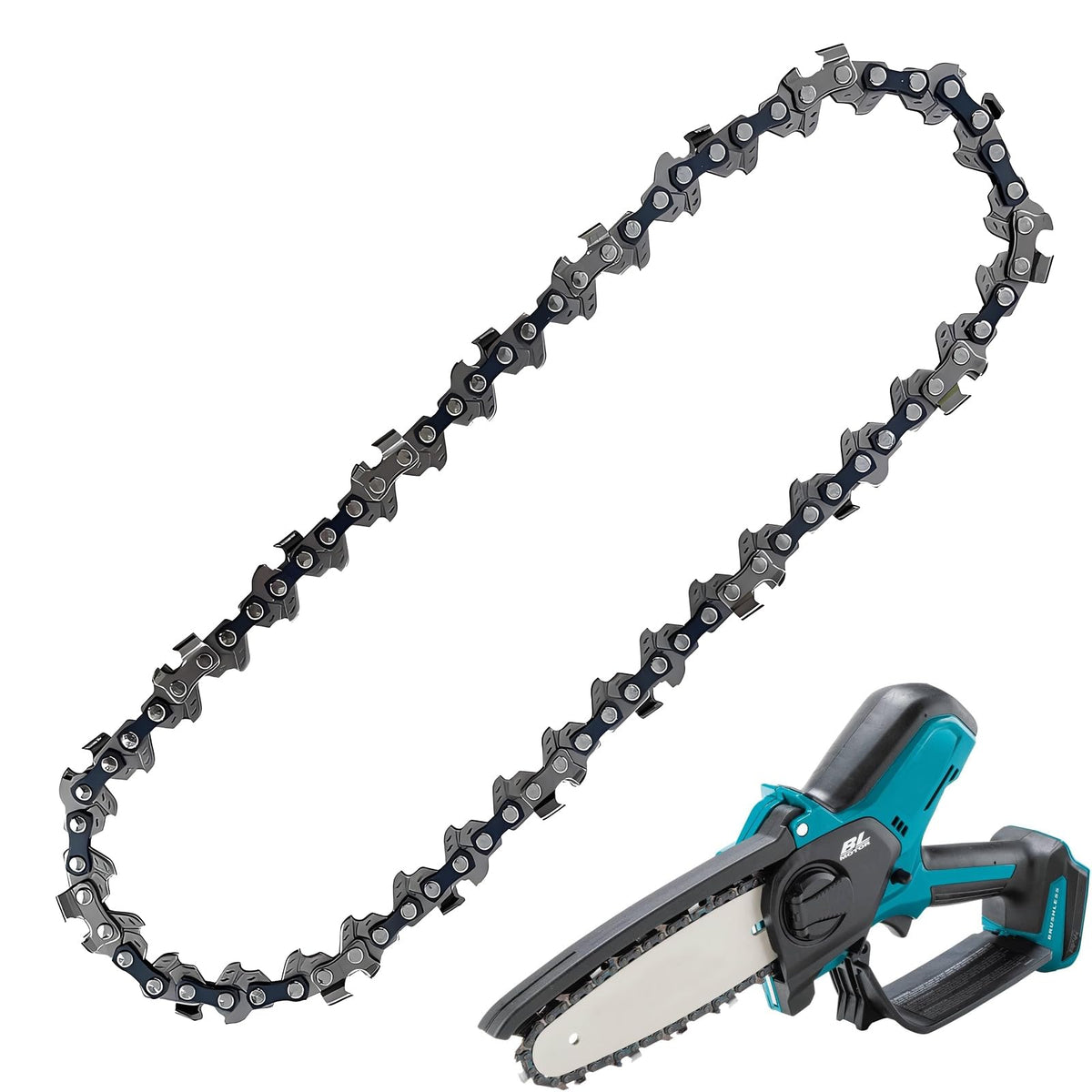
Opuladuo T-05907 6-inch replacement saw chain (.325" low-profile pitch, .043" gauge, 32 drive links), shown coiled. Photo from the product page linked below.
The short answer
There are five main chainsaw chain types: full chisel, semi-chisel, low-profile, skip tooth, and ripping chain. For most homeowners cutting firewood and clearing brush, a semi-chisel or low-profile chain is the right choice â they stay sharp longer and kick back less than a full chisel chain. Full chisel is fastest in clean wood but dulls quickly in dirt or frozen wood. Skip tooth suits long bars, and ripping chain is made for cutting planks along the grain (chainsaw milling), not for crosscutting.
Whichever type you choose, the chain must match three measurements on your guide bar: pitch, gauge, and drive link count. Get any one wrong and the chain will not fit, even if the bar length is right.
Chainsaw chain types compared
| Chain type | Cutter shape | Cuts fastest in | Best for | Trade-off |
|---|---|---|---|---|
| Full chisel | Square-cornered cutters | Clean softwood | Felling and bucking clean timber; professional use | Dulls fast in dirt, frozen, or hardwood; higher kickback tendency |
| Semi-chisel | Rounded-corner cutters | Dirty, hard, or frozen wood | Firewood, storm cleanup, general homeowner use | Slightly slower than full chisel in clean wood |
| Low-profile | Small, narrow cutters | Light wood and pruning | Homeowner, electric, and pole saws | Least aggressive cut; not for heavy felling |
| Skip tooth | Fewer cutters, wider spacing | Long bars (24"+), big cuts | Long-bar cutting, milling, clearing large timber | More vibration; poor choice for short bars |
| Ripping chain | Cutters ground at a shallow angle (~10°) | Along the grain | Chainsaw milling lumber into planks | Slow and unsafe for crosscutting â do not use for felling or bucking |
Chain types describe cutter geometry, not size. A chain's size â pitch, gauge, and drive link count â is a separate question covered below.
Full chisel chain
Full chisel cutters have square corners that bite aggressively and cut fast. In clean softwood, no other chain type cuts faster. The downside is edge life: the sharp square corner dulls quickly the moment it touches dirt, sand, frozen wood, or hard knots. Full chisel chains also tend to kick back more than rounded cutters, so they suit experienced users cutting clean timber â felling and bucking â rather than yard cleanup where the chain is likely to hit the ground.
Semi-chisel chain
Semi-chisel cutters have rounded corners. They cut slightly slower than full chisel in clean wood, but the rounded edge holds up far better in dirty, hard, or frozen wood, and it is more forgiving of occasional contact with the ground. Kickback tendency is lower than full chisel. For most homeowners â firewood cutting, storm cleanup, limbing â semi-chisel is the best all-round choice, because real-world cutting is rarely clean.
Low-profile chain
Low-profile chains use smaller, narrower cutters with built-in kickback-reduction features. They cut smoothly and with the lowest kickback tendency of the common types, which is why they are standard on most homeowner, electric, and pole saws. Common sizes are 3/8" low-profile pitch with .043" or .050" gauge. The trade-off is cutting aggression: a low-profile chain is not the right tool for felling large trees, but it is the safest and most practical choice for pruning, light limbing, and small saws.
Skip tooth chain
Skip tooth (skip-sequence) chains have fewer cutters â roughly every other cutter position is left empty â which leaves more room for chips to clear. That matters on long bars (24 inches and up), where a standard chain can clog with chips. Skip tooth chains are used for long-bar cutting and for chainsaw milling. They vibrate more than standard chains and cut slower on short bars, so they are not a general-purpose upgrade; they solve a specific problem on long bars.
Owners report the same trade-off in practice. In a TractorByNet thread about fitting a skip chain to a 24" bar, one owner writes that a "skip chain will let it pull easier but will cut slower," and warns that "skip tooth is grabbier on smaller stuff" â plus a reminder to check that the saw's oiler can keep up with a long bar (source).
Ripping chain
Ripping chain is ground at a shallow top-plate angle (around 10°, versus roughly 25â35° for a crosscut chain) so it slices along the wood grain instead of across it. It is made for one job: chainsaw milling â cutting logs lengthwise into planks. It leaves a smooth finish and pulls steadily through a long rip cut. Do not use a ripping chain for crosscutting, felling, or bucking: it cuts slowly across the grain and increases kickback risk in that use.
One miller on Alaska Outdoors Forums describes a ripping chain as "nearly identical to a standard chain except the cutters are filed at 10 degrees instead of 30 or so," and found that standard chain "actually cuts a little faster but leaves a rougher surface" (source).
How to read pitch, gauge, and drive links
These three numbers define whether a chain fits your saw. They are usually stamped on the guide bar, and they are also listed in your saw's manual.
- Pitch is the spacing between the chain's drive links â commonly 1/4", .325", 3/8" low-profile, 3/8", or .404". It must match your bar's nose sprocket and the drive sprocket.
- Gauge is the thickness of the drive links, which must match the width of the bar's groove â commonly .043", .050", .058", or .063". A gauge that is too thick will not sit in the groove; too thin and the chain wobbles.
- Drive links (DL) is the count of drive links in the loop. It determines the chain's length for your bar. Two chains with the same pitch and gauge but different drive link counts will not interchange.
When buying a replacement, match all three numbers plus the bar length. The chain type (full chisel, semi-chisel, and so on) is your cutting choice; pitch, gauge, and drive links are your fitment requirement.
Which chain should you buy?
Chain type is your cutting choice; pitch, gauge, and drive links are your fitment requirement. Work through these three steps in order.
Step 1 â Read your guide bar stamp. The bar is stamped with its pitch, gauge, and drive link count (and the bar length). Those four numbers are the only fitment data that matters. If the stamp is worn off, check your saw's manual or measure the old chain: count every drive link, and read the pitch and gauge codes stamped on the drive links.
Step 2 â Pick the type for your wood and task.
- Cutting firewood, storm cleanup, or dirty/mixed wood â semi-chisel. It stays sharp longest in real-world conditions.
- Felling and bucking clean softwood, and you sharpen often â full chisel. Fastest cut, but it dulls the moment it touches dirt.
- Homeowner, electric, or pole saw; pruning and light limbing â low-profile. Lowest kickback tendency, least aggressive cut.
- Bar 24" or longer, or a smaller saw struggling to pull a long bar â skip tooth. Fewer cutters, easier pull, slower cut.
- Milling logs lengthwise into planks â ripping chain. Nothing else is made for that job.
Step 3 â Match all four numbers before ordering. Bar length + pitch + gauge + drive link count must all match the replacement. If any one is off, the chain will not fit or will not cut safely â even if the other three are right. When in doubt, compare against the numbers on your bar stamp, not against a chain that "looks the same."
Common buying mistakes
- Buying by bar length only. Two 16" bars can take different pitch, gauge, and drive link counts. Bar length alone never identifies a chain.
- Confusing 3/8" LP with 3/8". 3/8" low-profile is a smaller chain design than standard 3/8". Same nominal pitch, different chain â they do not interchange.
- Ignoring gauge. A chain with the wrong gauge will not sit in the bar groove (too thick) or will wobble in it (too thin).
- Miscounting drive links. Count every drive link in the loop, not the cutters. One link off and the chain will not fit your bar.
- Using a ripping chain for crosscutting. Ripping chain is ground for cutting along the grain. On a crosscut it is slow and increases kickback risk.
- Forgetting the oiler on a long bar. A longer bar needs more oil. Before fitting a long-bar chain, confirm your saw's oiler can keep up â a dry chain dulls fast and wears the bar.
Find your replacement chain
These are the replacement chains and bar-and-chain combos we stock. Each product page lists the models it fits â confirm yours before ordering.
- Makita pruning saws â T-05907 6" Saw Chain for Makita XCU14 Pruning Saw (.325 LP .043 32DL) â semi-chisel low-profile teeth, .325" low-profile pitch, .043" gauge, 32 drive links. Fits Makita XCU14Z, XCU14, XCU14SR1, DUC150.
- Greenworks / Ryobi 16" saws â 16" Chainsaw Bar & 3 Chains for Greenworks CS80L417, Ryobi RY3716 â bar-and-chain combo, 3/8" low-profile pitch, .050" gauge, 56 drive links. Fits Greenworks CS80L417, Ryobi RY3716, and other models listed on the product page.
- Sun Joe / Worx 10" pole saws â 10" Pole Saw Bar & Chain for Sun Joe SWJ803E SWJ807E, Worx WG309 â bar-and-chain combo, 3/8" low-profile pitch, .050" gauge, 40 drive links. Fits Sun Joe SWJ803E, SWJ807E, Worx WG309, and other models listed on the product page.
Don't see your saw? Browse all chainsaw bars & chains.
FAQ
What is the difference between full chisel and semi-chisel chain?
Full chisel cutters have square corners that cut fastest in clean wood but dull quickly in dirt, frozen wood, or hardwood. Semi-chisel cutters have rounded corners that cut slightly slower but stay sharp longer in dirty or hard wood, with lower kickback tendency. For most homeowners, semi-chisel is the better all-round choice.
What chain is best for hardwood?
Semi-chisel is usually the best choice for hardwood. Hardwood dulls a square-cornered full chisel edge quickly, while a rounded semi-chisel edge holds up longer. If the wood is dirty, frozen, or likely to contact the ground, semi-chisel's advantage grows.
What does 3/8" pitch mean on a chainsaw chain?
Pitch is the spacing between the chain's drive links. 3/8" pitch means the distance between three consecutive rivets, divided by two, is 3/8 of an inch. It must match your bar's nose sprocket and drive sprocket. Note that 3/8" low-profile (3/8" LP) is a different, smaller chain design than standard 3/8" â they do not interchange.
What is a low-profile chainsaw chain?
A low-profile chain uses smaller, narrower cutters with built-in kickback-reduction features. It is standard on most homeowner, electric, and pole saws, commonly in 3/8" low-profile pitch with .043" or .050" gauge. It cuts smoothly with low kickback but is not meant for heavy felling.
What is a skip tooth chain used for?
Skip tooth chains have fewer cutters and wider spacing, which improves chip clearance on long bars (24 inches and up). They are used for long-bar cutting and chainsaw milling. They vibrate more and cut slower on short bars, so they are not a general-purpose chain.
What chain do I need for chainsaw milling?
A ripping chain. It is ground at a shallow angle (around 10°) to cut along the grain, producing smooth planks. Do not use it for crosscutting, felling, or bucking â it cuts slowly across the grain and increases kickback risk in that use.
How do I know which chain fits my saw?
Check the stamp on your guide bar or the specs in your saw's manual for three numbers: pitch, gauge, and drive link count, plus the bar length. Match all four when buying a replacement. The chain type (full chisel, semi-chisel, low-profile, and so on) is your cutting choice; pitch, gauge, and drive links are the fitment requirement.
Should I use a skip tooth chain on a 24-inch bar?
It depends on your saw's power. A skip tooth chain has fewer cutters, so it pulls easier and lets a smaller saw run a long bar without bogging down â but it cuts slower, and it is grabbier on smaller wood. Owners who run skip chains on 24" bars report the same trade-off: easier pull, slower cut. If your saw already pulls a full-complement chain on that bar without struggling, you do not need skip tooth.
Sources
- Oregon Forestry & Tree Care FAQs (PDF) â Oregon-authored FAQ document (hosted on Home Depot's image CDN). Supports the cutter-type descriptions (full chisel, semi-chisel, low-profile), the pitch definition (distance between three consecutive rivets divided by two), the gauge definition, and the rule that drive link count must match the guide bar.
- STIHL Saw Chain Selection & Identification (PDF) â STIHL document (hosted on a distributor's asset CDN). Supports decoding pitch and gauge from chain markings, the full-skip / semi-skip codes, and the green/yellow kickback color-code system.
- TractorByNet forum â "Skip chain for longer bar use?" (thread) â Owner discussion. Supports the skip tooth trade-off on a 24" bar (easier pull, slower cut), the warning that skip tooth is grabbier on smaller wood, and the oiler-output reminder for long bars.
- Alaska Outdoors Forums â "Chainsaw Milling" (thread) â Owner discussion. Supports the ripping chain description (cutters filed at 10° instead of ~30°) and the finding that standard chain cuts slightly faster but leaves a rougher surface when milling.
Guide by the Opuladuo Parts Team. We sell replacement chainsaw bars and chains for major brands. Every chain and bar-and-chain combo we list shows the brands and model numbers it fits on its product page â check yours there before ordering. Chain types are general cutting guidance â always confirm pitch, gauge, and drive link count against your guide bar before ordering.
Check your model number before ordering. Every product page lists the brands and model numbers it fits. Not sure? Ask us.
Verifica tu número de modelo antes de pedirCada página de producto indica las marcas y números de modelo compatibles. ¿No estás seguro? Escríbenos.


